
Public Washrooms Can Be Beautiful Too
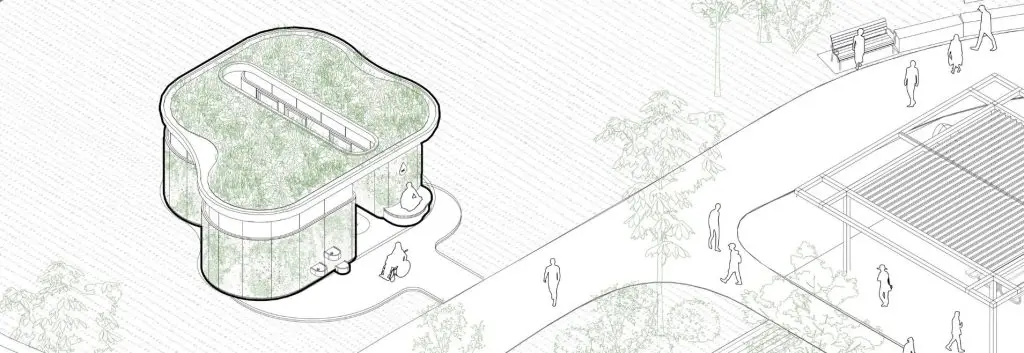
Alea Reid and Petra Matar of Design Partners in Architecture and Interiors in Hamilton, Ontario won Toronto Public Space Committee and Cyan Station TO the Loo design competition to convince the City of Toronto that bathrooms can be an inspiring part of the public realm. (Rendering by Design Partners in Architecture and Interiors/Courtesy Toronto Public Space Committee)
We’ve all been there. The frantic search for a restroom, the urgent need for a toilet, the exasperation at a bathroom locked with a code “for customers only,” the impatient jig while waiting in line. And once inside, too often it’s worse: the stench overwhelming, toilet paper scattered, and a mysteriously wet floor. In response, the Toronto Public Space Committee, together with Cyan Station Architecture, launched the TO the Loo design competition to highlight the city’s shortage of public restrooms and to show that bathrooms can be an inspiring part of the public realm.
“Despite the necessity of public washrooms, Toronto has a severe shortage, leaving many residents—particularly unhoused individuals, gig workers, families, and people with disabilities—without access to this fundamental urban infrastructure,” said Car Martin, lead architect at Cyan Station Architecture and competition host. “This competition has brought forward incredible solutions to a pressing urban issue.”
On July 10, the winners and runners-up of the TO the Loo design competition were announced, along with a people’s choice winner. The initiative drew more than 50 submissions from across the globe; each explores how sanitation infrastructure could embody accessibility, sustainability, and cultural inclusion. All of the entries are currently being presented at an exhibition in Toronto.
Mycomorph: Modular Scalar Washrooms for Toronto’s Green Spaces, designed by Alea Reid and Petra Matar of Hamilton’s Design Partners in Architecture and Interiors (DPAI) took first place. Their concept envisions sculptural, mushroom-inspired pods built from durable precast concrete. The modular units are designed for scalability and can be adapted to Toronto’s diverse park sites. A unifying canopy integrates rainwater collection, daylighting, and even ambient sound art.
Inside, the pods prioritize hygiene and ease of maintenance with anti-graffiti epoxy finishes, floor drains, and robust fixtures. Community input shapes color choices, while green roofs and passive ventilation enhance environmental performance. Mycomorph is also a model of spatial justice: its gender-neutral, accessible, and shower-equipped units provide dignified hygiene access for all. Safety features include emergency call strips, naloxone access, and sharps containers, while exterior panels inscribe greetings in local languages and even support living moss growth.
Or read the full article by the International Fire and Safety Journal HERE.