
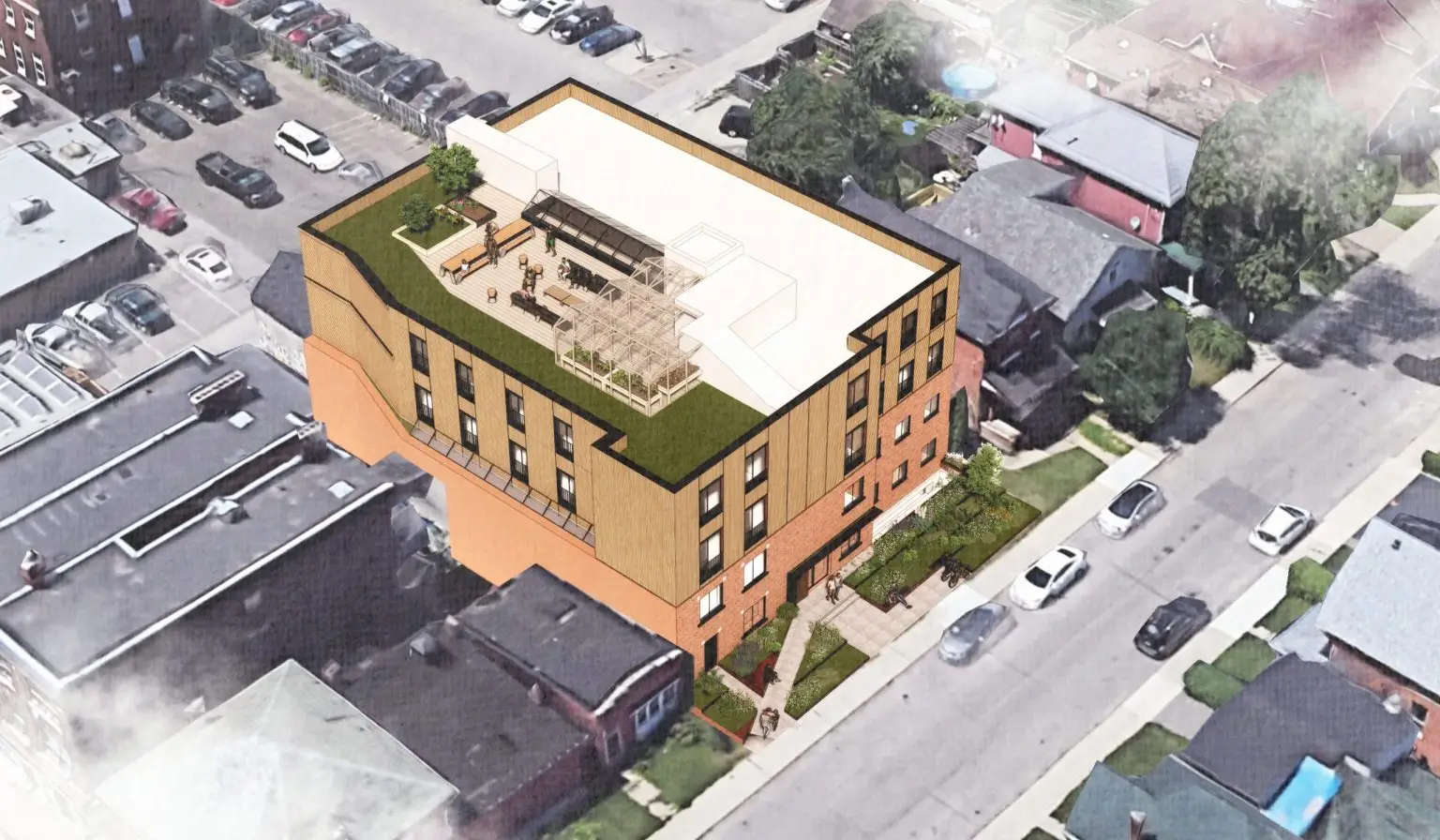
Wayside House of Hamilton’s future residential treatment centre on East Avenue North will give it more beds and include supportive housing.
DPAI Architecture Inc. rendering
Wayside House of Hamilton has helped thousands of men overcome addiction in a large, stately brick home on Charlton Avenue West for more than a half-century.
But a few years ago, the non-profit decided it needed to address a growing wait-list for services amid an escalating addiction crisis in Ontario.
“We’ve just outgrown ourselves,” CEO Regan Anderson told The Spectator about the board’s decision to build a larger centre on East Avenue North.
Offering services promptly is “critical” when someone makes the significant decision to tackle addiction through treatment, he said. “People are dropping off the wait-list because they’ve either given up or some of them have passed away.”
The average wait for Wayside’s services is six to eight weeks.
Wayside’s home on Charlton also has limited accessibility, posing barriers for prospective clients in wheelchairs, for instance.
“That’s unfair. That’s unacceptable on any level,” Anderson said.
After years of planning, Wayside recently took another step toward a larger home through city-approved zoning changes.
The East Avenue project near Barton Street involves renovating a two-storey warehouse and putting a two-storey addition on top.
The roughly $15-million project will roughly double Wayside’s treatment beds to up to 60 and feature 15 supportive-housing units.
The bachelor apartments are meant to help fill a “gap” in services for those who finish treatment but still need intense support afterward, Anderson noted.
“A lot of individuals completing residential treatment aren’t, from our experience, housing-ready.”
Wayside has offered supportive housing in standalone, rented homes for decades.
But the future building would provide this accommodation under the same roof until clients are ready to transition to other housing.
The “hub” or “campus” model will offer an array of services on-site, meaning clients don’t have to venture out to receive them.
Through health and social-service partners, the goal is to make that integrated “delivery of care as seamless as possible,” Anderson said.
The East Avenue design calls for clinic, counselling and education space, staff offices, and cooking and dining areas. The blueprint also features a rooftop garden.
Supportive housing, specifically for those with addiction and mental-health challenges, is in short supply with long wait-lists for care in Ontario.
“Demand far exceeds supply, wait lists are at crisis levels and funding models are fragmented,” found a 2025 report for Addictions and Mental Health Ontario (AMHO).
“These conditions have created bottlenecks that leave individuals without the housing and support they need, when and where they need it.”
Wayside’s provincially funded program treats all walks of life, whether clients are professionals with homes or men living on the street, Anderson said.
The substances — alcohol, cocaine or opioids, for example — also vary.
“The common denominator is basically their lives become unmanageable because of their substance use,” Anderson said.
Wayside has more work ahead, including the city’s site-plan process, before it starts repurposing the East Avenue building.
The agency is also working with Ontario’s health ministry on operational funding, Anderson noted.
Meanwhile, the lion’s share of the construction cost is to be covered through fundraising.
Anderson suggested Wayside could “leverage” its Charlton location toward that goal or keep it for some services.
There, the agency has coexisted for years with neighbours, which include a long-term-care home, condos and professional offices.
That’s also Wayside’s plan for East Avenue, Anderson said.
“So when people walk by, they’ll see a pleasant building in a pleasant neighbourhood, regardless of the function.”
If you would like to view the official article, click here.